J-style kayak racks are popular for a reason — they’re compact, stable, and compatible with most crossbars. But not all are created equal. Here’s how to pick the right one for your needs.
J-style kayak racks carry your boat on its side, maximizing roof space while keeping the kayak secure. They’re compatible with most factory or aftermarket crossbars and are favored for their balance of stability and efficiency. But different mounting mechanisms, materials, and features — like folding frames or integrated tie-downs — can make or break your experience. This guide covers the core styles and what matters most when choosing a J-rack system.
Key Takeaways:
- J-racks angle kayaks to save roof space and cut drag.
- Popular choice for kayaks under 100 lbs.
- Crossbar shape/width affects rack compatibility.
- Key factors: folding vs fixed, strap quality, padding thickness.
- Best for reachable roofs — tall SUVs may need a step stool.
Why J-Style Racks Are So Popular?
For most casual kayakers, J-style racks hit the sweet spot.
They’re compact, affordable, and they let you carry your kayak on its side, freeing up space on your roof for another kayak, a cargo box, or fishing rods.
They also reduce wind resistance compared to flat cradles and make strapping easier by exposing the full kayak hull.
But not all J-racks are equal. Some clamp easily to factory bars; others require tools. Some fold down when not in use; others stick straight up and become a garage clearance hazard. And while they all follow the same basic shape, their actual performance varies significantly in padding, adjustability, and ease of use.
The 3 Main Types of J-Style Kayak Racks
1. Fixed J-Cradles
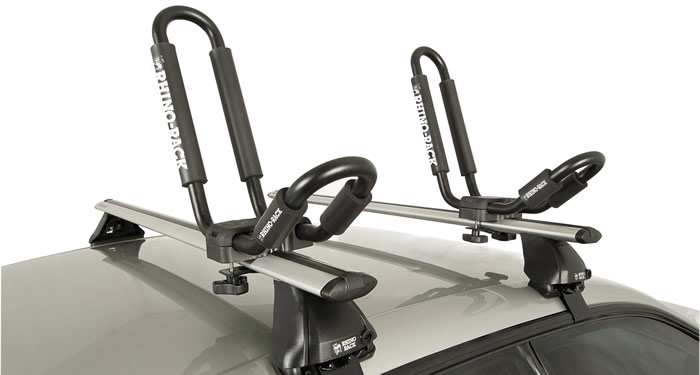
Best for: Simple, budget-conscious users who load occasionally
These are the original form: a curved, upright metal cradle that stays in the “J” shape at all times. They offer solid support and are usually the most affordable option. They clamp directly onto your crossbars, and once installed, they’re always ready for use.
Pros:
- Inexpensive and widely available
- Easy to load and strap
- Secure with minimal moving parts
Cons:
- Always upright — can limit garage clearance
- May whistle or rattle when empty
- No adjustability or folding mechanism
2. Folding J-Racks
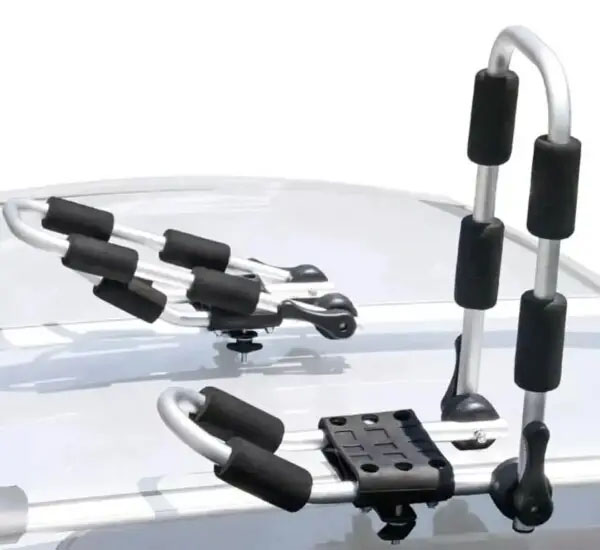
Best for: Frequent users or garage parkers with height concerns
These models have a hinge at the base, allowing the rack to fold flat when not in use. That reduces drag, improves overhead clearance, and gives your car a cleaner look. Folding J-racks are ideal for people who paddle often and want to leave their racks mounted full-time.
Pros:
- Folds down when not in use
- Easier to park or drive-through
- Often better materials and padding
Cons:
- Slightly heavier and pricier
- Hinges can wear or loosen over time
- More complex installation on some bars
3. J-Racks with Load Assist Features
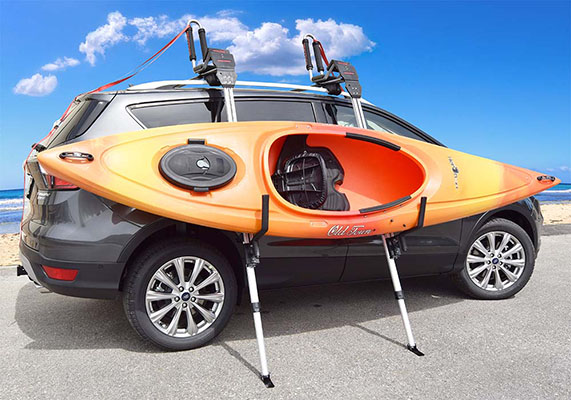
Best for: Solo paddlers, heavier kayaks, or taller vehicles
Some modern J-racks come with sliding arms, extension poles, or roller-assist systems to help lift and guide the kayak into place. These are especially useful for those loading alone, or for SUVs where lifting overhead is more challenging.
Pros:
- Easier solo loading
- Reduces risk of scratching your car
- Great for heavier kayaks (70–100 lbs)
Cons:
- More expensive
- Fewer models available
- May require crossbars with specific length or position
What to Consider Before You Buy
Crossbar Compatibility
Not all J-racks work with all crossbars. Factory bars — especially on Subaru, Toyota, or Mazda models — often have non-standard shapes or fixed widths. Some J-racks don’t clamp well onto aero-style or oval bars, and others require T-track adapters for proper fit.
Always check:
- Your crossbar width and shape (round, square, aero)
- The max weight your bars can support
- Whether your rack requires tools or is tool-free
If in doubt, universal clamping systems are safer — but not always the most secure.
Kayak Weight and Size
Most J-racks support kayaks between 35 and 100 lbs and up to 36 inches wide. If your kayak is on the heavier end, make sure the rack frame is reinforced and the padding is thick enough to handle repeated loading.
Aluminum racks tend to be lighter and corrosion-resistant, while steel models are often stronger but heavier.
If you’re hauling a particularly long kayak (13+ ft), ensure the support angles match the curvature of your hull — some J-racks are better suited for whitewater boats than touring kayaks.
Padding and Protection
The main contact points between the kayak and the rack should be:
- Foam-padded or rubber-coated
- Textured or grooved to reduce slipping
- Replaceable (ideally) if the foam degrades over time
Thin or slick padding increases the risk of hull damage during bumpy roads or windy driving. If you’re hauling a composite kayak or a boat with painted finishes, avoid bare metal contact at all costs.
Strap Quality and Tie-Down Design
A good J-rack is only as secure as its tie-down system. Look for:
- Cam buckle straps (not ratchets)
- Strap guides or loops built into the frame
- Bow and stern tie-downs with adjustable hooks
- Weather-resistant strap material
Many budget J-racks ship with flimsy straps that are worth replacing immediately. If loading alone, having integrated strap channels makes the process safer and faster.
Vehicle Height and Loading Position
J-racks raise your kayak above roof level, meaning that on SUVs and vans, loading can get tricky — especially solo.
If you’re short or have limited mobility, consider:
- A folding step stool or side ladder
- Roller guides or extension poles
- Hitch-mounted rear support (goalpost-style)
For sedans and wagons, J-racks are usually manageable without help — especially if your kayak is under 50 lbs.
Which J-Style Rack Fits Your Setup?
| Use Case | Best J-Rack Style |
|---|---|
| You park in a garage | Folding J-rack that collapses flat |
| You load a 75+ lb kayak | Reinforced J-rack with thick padding |
| You paddle alone frequently | J-rack with load assist or roller arm |
| You have factory crossbars | Clamp-based rack with aero compatibility |
| You want the most budget-friendly option | Fixed J-cradle with cam straps |
Final Thoughts
J-style racks remain the most efficient and practical way to transport a kayak on your roof — especially if you’re using factory or aftermarket crossbars. They’re versatile, compact, and time-tested. But the differences between folding, fixed, and assisted models matter more than people realize.
If you’re loading alone, parking in a garage, or dealing with crossbar quirks, it’s worth choosing a J-rack that matches your specific setup. A little extra upfront planning can save you serious hassle at the put-in and back at home.